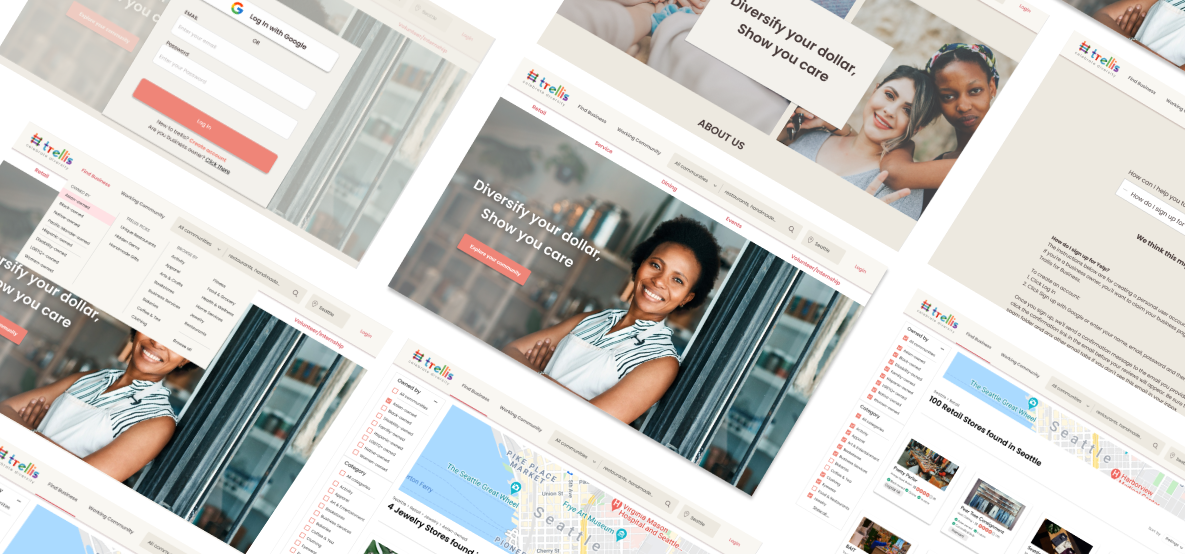
A platform where consumers can discover, connect with, and support minority-owned small businesses, and find local volunteer or internship opportunities to give back to their community.
As social movements gained momentum, more people wanted to spend money ethically and intentionally, but finding minority-owned small businesses that fit specific needs was time-consuming without word of mouth. Community volunteer and internship opportunities were similarly hard to discover, rarely centralized in one place.
"How might I bridge the gap in representation by designing a platform that promotes minority-owned small businesses and connects consumers with community opportunities?"
Semi-structured 1-on-1 interviews with minority-owned business owners, recruited via social media and personal network, to understand their individual values and mission.
An interactive discussion with consumers who preferred shopping locally, focused on their habits, frustrations, and barriers.
Two surveys, one for consumers and one for business owners, shared across Slack, social networks, and personal connections to identify behavioral patterns at scale.
Transcribed sessions and built an affinity map to organize themes, then developed primary, secondary, and tertiary personas from the combined interview, focus group, and survey data.
Sequenced across 9 weeks: roughly 3 weeks for recruitment and interviews, 2 weeks for synthesis, and the remainder for design and validation, with recruitment running longest since it depended on busy business owners' availability.
Recruiting 4 business owners running their own shops meant working entirely around their hours, often early morning or after closing. Split outreach across the team of 3 to cover more ground through social media and personal networks simultaneously.
After a competitive analysis against platforms like Nextdoor and Yelp, I sketched initial concepts, built low-fidelity screens for landing, directory, and search/filter flows, then storyboarded three core journeys. A medium-fidelity Figma prototype was tested with 6 participants on task-based scenarios, and the results shaped the final high-fidelity design, including a new slogan and logo, restructured information architecture for ownership categories, an improved filtering system, and a new "Internships & Opportunities" wizard.
I came away with a deep appreciation for how much dedication it takes to keep a small business going, and for the owners who are genuinely committed to social causes despite real challenges around visibility and technical upkeep.
The biggest lesson: designing with intention is hard. Usability testing reminded me that I am not the user; what feels intuitive to me doesn't always resonate the same way with others. I wasn't able to run as many sessions as I wanted due to time constraints, and I see that as a real area for growth. This project reinforced why I care about user-centered design: building tools that empower people whose voices are often overlooked.